Showing posts with label NASA news. Show all posts

Thursday, February 27, 2020

Libera is NASA's New Instrument to Continue Key Climate Record

NASA released the statement below regarding its new space-based instrument that would continue the 40-year climate data record.

***
NASA has selected a new space-based instrument as an innovative and cost-effective approach to maintaining the 40-year data record of the balance between the solar radiation entering Earth’s atmosphere and the amount absorbed, reflected, and emitted. This radiation balance is a key factor in determining our climate: if Earth absorbs more heat than it emits, it warms up; if it emits more than it absorbs, it cools down.

The new instrument, named Libera, is NASA’s first mission selected in response to the 2017 National Academies’ Earth Science Decadal Survey. The project’s principal investigator is Peter Pilewskie of the University of Colorado Laboratory for Atmospheric and Space Physics in Boulder, Colorado.
“This highly innovative instrument introduces a number of new technologies such as advanced detectors that will improve the data we collect while maintaining continuity of these important radiation budget measurements,” said Sandra Cauffman, acting director of the Earth Science Division at NASA Headquarters in Washington.

Libera will measure solar radiation with wavelengths between 0.3 and 5 microns reflected by the Earth system and infrared radiation with wavelengths between 5 and 50 microns emitted from the Earth system as it exits the top of the atmosphere. The sensor will also measure the total radiation leaving the Earth system at all wavelengths from 0.3 to 100 microns. An innovative additional “split shortwave” channel measuring radiation between 0.7 and 5 microns has been added to enable new Earth radiation budget science.

These wavelength ranges allow scientists to understand changes to Earth’s climate system such as whether the planet is getting brighter or darker, and heating up or cooling down. The data will be available publicly following a brief checkout and commissioning period.
The new instrument was selected competitively from four proposals considered under NASA's first Earth Venture Continuity opportunity, a new type of investigation in this class. NASA Earth Venture missions are led by principal investigators, competitively selected, and are cost- and schedule-constrained.

Earth Venture Continuity missions focus on demonstrating innovative, low-cost approaches to maintaining targeted measurements important to the Earth science community in an unbroken and consistent way. The National Academies’ Decadal Survey recommended this new way to continue existing measurements of vital importance over the long term.

Libera is named after the daughter of Ceres, the Roman goddess of agriculture. The name acknowledges the relationship between this new mission and the Clouds and the Earth's Radiant Energy System (CERES) instruments that currently make the radiation balance measurements that Libera will continue. Six CERES instruments are currently collecting data on NASA and National Oceanic and Atmospheric Administration satellites.

The new research instrument will fly on NOAA’s operational Joint Polar Satellite System-3 (JPSS-3) satellite, which is scheduled to launch by December 2027.

Earth Venture missions are managed by the Earth System Science Pathfinder program, located at NASA’s Langley Research Center in Hampton, Virginia, for the agency’s Science Mission Directorate.

For more information about the Earth Venture program, visit:


NASA uses the vantage point of space to increase our understanding of our home planet, improve lives, and safeguard our future. NASA develops new ways to observe and study Earth's interconnected natural systems with long-term data records. The agency freely shares this unique knowledge and works with institutions around the world to gain new insights into how our planet is changing.

For more information about NASA’s Earth science activities, visit:

Monday, February 24, 2020

NASA Administrator Statement on Passing of Katherine Johnson

The following is a statement from Administrator Jim Bridenstine on the passing of NASA legend Katherine Johnson, who worked for the agency from 1953 to 1986.

“NASA is deeply saddened by the loss of a leader from our pioneering days, and we send our deepest condolences to the family of Katherine Johnson. Ms. Johnson helped our nation enlarge the frontiers of space even as she made huge strides that also opened doors for women and people of color in the universal human quest to explore space. Her dedication and skill as a mathematician helped put humans on the moon and before that made it possible for our astronauts to take the first steps in space that we now follow on a journey to Mars. Her Presidential Medal of Freedom was a well-deserved recognition.

“At NASA we will never forget her courage and leadership and the milestones we could not have reached without her. We will continue building on her legacy and work tirelessly to increase opportunities for everyone who has something to contribute toward the ongoing work of raising the bar of human potential.”

SOURCE

Thursday, April 16, 2015

Landsat 9 Satellite To Launch in 2023 To Continue Land Imaging Legacy

NASA and the U.S. Geological Survey (USGS) have started work on Landsat 9, planned to launch in 2023, which will extend the Earth-observing program’s record of land images to half a century.

The Landsat program has provided accurate measurements of Earth’s land cover since 1972. With data from Landsat satellites, ecologists have tracked deforestation in South America, water managers have monitored irrigation of farmland in the American West, and researchers have watched the growth of cities worldwide. With the help of the program’s open archive, firefighters have assessed the severity of wildfires and scientists have mapped the retreat of mountain glaciers.

The President’s fiscal year 2016 budget calls for initiation of a Landsat 9 spacecraft as an upgraded rebuild of Landsat 8, as well as development of a low-cost thermal infrared (TIR) free-flying satellite for launch in 2019 to reduce the risk of a data gap in this important measurement. The TIR free flyer will ensure data continuity by flying in formation with Landsat 8. The budget also calls for the exploration of technology and systems innovations to provide more cost effective and advanced capabilities in future land-imaging missions beyond Landsat 9, such as finding ways to miniaturize instruments to be launched on smaller, less expensive satellites.

“Moving out on Landsat 9 is a high priority for NASA and USGS as part of a sustainable land imaging program that will serve the nation into the future as the current Landsat program has done for decades,” said John Grunsfeld, associate administrator for science at NASA Headquarters, Washington. “Continuing the critical observations made by the Landsat satellites is important now and their value will only grow in the future, given the long term environmental changes we are seeing on planet Earth.”

Because an important part of the land imaging program is to provide consistent long-term observations, this mission will largely replicate its predecessor Landsat 8. The mission will carry two instruments, one that captures views of the planet in visible, near infrared and shortwave-infrared light, and another that measures the thermal infrared radiation, or heat, of Earth’s surfaces. These instruments have sensors with moderate resolution and the ability to detect more variation in intensity than the first seven satellites in the Landsat program.

The Landsat 9 mission is a partnership between NASA and the USGS. NASA will build, launch, perform the initial check-out and commissioning of the satellite; USGS will operate Landsat 9 and process, archive, and freely distribute the mission’s data.

"Landsat is a remarkably successful partnership," said Sarah Ryker, USGS deputy associate director for climate and land use change, Reston, Virginia. "Last year the White House found that GPS, weather satellites, and Landsat are the three most critical types of Earth-orbiting assets for civil applications, because they're used by many economic sectors and fields of research. Having Landsat 9 in progress, and a long-term commitment to sustainable land imaging, is great for natural resource science and for data-driven industries such as precision agriculture and insurance."

NASA’s Goddard Space Flight Center in Greenbelt, Maryland, will lead development of the Landsat 9 flight segment. Goddard will also build the Thermal Infrared Sensor (TIRS), which will be similar to the TIRS that the center built for Landsat 8. The new improved TIRS will have a five-year design lifetime, compared to the three-year design lifetime of the sensor on Landsat 8.

"This is good news for Goddard, and it’s great news for the Landsat community to get the next mission going," said Del Jenstrom, the Landsat 9 project manager at NASA Goddard. "It will provide data consistent with, or better than, Landsat 8."

With decades of observations, scientists can tease out subtle changes in ecosystems, the effects of climate change on permafrost, changes in farming technologies, and many other activities that alter the landscape.

“With a launch in 2023, Landsat 9 would propel the program past 50 years of collecting global land cover data,” said Jeffrey Masek, Landsat 9 Project Scientist at Goddard. "That’s the hallmark of Landsat: the longer the satellites view the Earth, the more phenomena you can observe and understand. We see changing areas of irrigated agriculture worldwide, systemic conversion of forest to pasture – activities where either human pressures or natural environmental pressures are causing the shifts in land use over decades.”

"We have recognized for the first time that we’re not just going to do one more, then stop, but that Landsat is actually a long-term monitoring activity, like the weather satellites, that should go on in perpetuity," Masek said.

NASA uses the vantage point of space to increase our understanding of our home planet, improve lives, and safeguard our future. NASA develops new ways to observe and study Earth's interconnected natural systems with long-term data records. The agency freely shares this unique knowledge and works with institutions around the world to gain new insights into how our planet is changing.

For more information on the Landsat program, visit: http://landsat.gsfc.nasa.gov

SOURCE NASA, Landsat

Tuesday, February 03, 2015

SMAP Soil Moisture Mapping Satellite Launched

Press Release. NASA successfully launched its first Earth satellite designed to collect global observations of the vital soil moisture hidden just beneath our feet.

The Soil Moisture Active Passive (SMAP) observatory, a mission with broad applications for science and society, lifted off at 6:22 a.m. PST (9:22 a.m. EST) Saturday from Vandenberg Air Force Base, California, on a United Launch Alliance Delta II rocket.

About 57 minutes after liftoff, SMAP separated from the rocket's second stage into an initial 411- by 425-mile (661- by 685-kilometer) orbit. After a series of activation procedures, the spacecraft established communications with ground controllers and deployed its solar array. Initial telemetry shows the spacecraft is in excellent health.

SMAP now begins a three-year mission that will figuratively scratch below Earth's surface to expand our understanding of a key component of the Earth system that links the water, energy and carbon cycles driving our living planet. SMAP’s combined radar and radiometer instruments will peer into the top 2 inches (5 centimeters) of soil, through clouds and moderate vegetation cover, day and night, to produce the highest-resolution, most accurate soil moisture maps ever obtained from space.

The mission will help improve climate and weather forecasts and allow scientists to monitor droughts and better predict flooding caused by severe rainfall or snowmelt -- information that can save lives and property. In addition, since plant growth depends on the amount of water in the soil, SMAP data will allow nations to better forecast crop yields and assist in global famine early-warning systems.

"The launch of SMAP completes an ambitious 11-month period for NASA that has seen the launch of five new Earth-observing space missions to help us better understand our changing planet," said NASA Administrator Charles Bolden. "Scientists and policymakers will use SMAP data to track water movement around our planet and make more informed decisions in critical areas like agriculture and water resources."

SMAP also will detect whether the ground is frozen or thawed. Detecting variations in the timing of spring thaw and changes in the length of the growing season will help scientists more accurately account for how much carbon plants are removing from Earth's atmosphere each year.

"The next few years will be especially exciting for Earth science thanks to measurements from SMAP and our other new missions," said Michael Freilich, director of the Earth Science Division of NASA’s Science Mission Directorate in Washington. "Each mission measures key variables that affect Earth’s environment. SMAP will provide new insights into the global water, energy, and carbon cycles. Combining data from all our orbiting missions will give us a much better understanding of how the Earth system works."

SMAP will orbit Earth from pole to pole every 98.5 minutes, repeating the same ground track every eight days. Its 620-mile (1,000-kilometer) measurement swath allows SMAP to cover Earth’s entire equatorial regions every three days and higher latitudes every two days. The mission will map global soil moisture with about 5.6-mile (9-kilometer) resolution.

"SMAP will improve the daily lives of people around the world,” said Simon Yueh, SMAP project scientist at NASA's Jet Propulsion Laboratory (JPL) in Pasadena, California. "Soil moisture data from SMAP has the potential to significantly improve the accuracy of short-term weather forecasts and reduce the uncertainty of long-term projections of how climate change will impact Earth's water cycle.”

The SMAP team is engaged with many organizations and individuals that see immediate uses for the satellite’s data. Through workshops and tutorials, the SMAP Applications Working Group is collaborating with 45 “early adopters” to test and integrate the mission's data products into many different applications. Early adopters include weather forecasters from several nations, as well as researchers and planners from the U.S. Department of Agriculture, U.S. Geological Survey, U.S. Centers for Disease Control and Prevention, and the United Nations World Food Programme.

During the next 90 days, SMAP and its ground system will be commissioned to ensure they are fully functional and are ready to begin routine science data collection. A key milestone will be the deployment of the spacecraft’s instrument boom and 20-foot- (6-meter)-diameter reflector antenna. The observatory will be maneuvered to its final 426-mile (685-kilometer), near-polar operational orbit, and the antenna will spin up to 14.6 revolutions per minute.

SMAP science operations will then begin, and SMAP data will be calibrated and validated. The first release of SMAP soil moisture data products is expected within nine months. Fully validated science data are expected to be released within 15 months.

SMAP is managed for NASA's Science Mission Directorate in Washington by JPL, with instrument hardware and science contributions made by NASA's Goddard Space Flight Center in Greenbelt, Maryland. JPL built the spacecraft and is responsible for project management, system engineering, radar instrumentation, mission operations and the ground data system. Goddard is responsible for the radiometer instrument and science data products. Both centers collaborate on science data processing and delivery to the Alaska Satellite Facility, in Fairbanks, and the National Snow and Ice Data Center at the University of Colorado in Boulder. NASA's Launch Services Program at the agency's Kennedy Space Center in Florida was responsible for launch management. JPL is managed for NASA by the California Institute of Technology in Pasadena.

For more information about SMAP, visit: http://www.nasa.gov/smap

Wednesday, November 19, 2014

William T. Pecora Award Winners 2014 Announced

On Tuesday afternoon, at the Pecora 19 conference in Denver, Colorado, the U.S. Geological Survey and NASA presented a group Pecora Award to The Landsat 8 Team.

This group award recognizes a team that has made major breakthroughs in remote sensing science or technology that impact the user community.

The Landsat 8 Team—including members from NASA, USGS, and the aerospace industry—is being recognized for its role in developing, building, launching, and operating the highly successful Landsat 8 satellite. Landsat 8 carries on the more than four decade Landsat data record using advanced new sensors. Its data collections contribute towards our evolving understanding of Earth’s land surface and coastal regions.

The 2014 individual Pecora Award was presented to Christopher Justice. Dr. Justice, a leading remote sensing scientist, has served as a remote sensing advisor, educator, and research director. His work has advanced the field of remote sensing science while influencing and encouraging many of the field’s current innovators.

The William T. Pecora Award was established in 1974 to honor Pecora. Sponsored jointly by the Department of the Interior and NASA, it is presented annually to individuals or groups that make outstanding contributions toward understanding the Earth by means of remote sensing.

SOURCE NASA

Friday, November 07, 2014

Free NASA Forum on Changing Landscape: Observations from Space This Weekend

This Saturday, November 8, 2014, a NASA Climate Change Forum is being held at Howard Community College in Maryland. The forum will focus on urban, agricultural, and forest changes in the Chesapeake Bay watershed that result from development and climate change. The forum takes place tomorrow from from 9 a.m. to noon in the HCC’s Health Sciences Building.

Talks by Molly Brown (NASA) on food security, Peter Claggett (USGS) on the Chesapeake Bay, and Joseph Sexton (UMD) on land use change will be featured along with a panel Q&A, and related exhibits.

Register for this free event at http://howardcc.edu/NASAforum

Monday, August 25, 2014

2014 NASA EONS Solicitation New Appendix

NASA's Office of Education is accepting new proposals under the Education Opportunities in NASA STEM (EONS) 2014 NASA Research Announcement for the MUREP Institutional Research Opportunity (MIRO) appendix. This effort was previously titled as the NASA University Research Centers Project and has now been consolidated into the MUREP Program within the NASA Office of Education. Through the EONS omnibus solicitation, the opportunity MIRO has been released.

Overall, MIRO awards aim to promote Science, Technology, Engineering, and Math (STEM) literacy and to enhance and sustain the capability of minority serving institutions to perform NASA-related research and education, which directly supports NASA’s four Mission Directorates – Aeronautics Research, Human Exploration and Space Operations, Science, and Space Technology.

Proposals are due November 12, 2014.

For more information regarding the MIRO Solicitation, please visit the NASA EONS page in NSPIRES http://nspires.nasaprs.com/external/.

Thursday, August 07, 2014

Tuesday, July 15, 2014

Search for Life in the Universe at NASA (Full Video)

You may be interested with this recent video from NASA featuring space experts discussing the search for Life in the vast universe.

"NASA space-based observatories are making unprecedented new discoveries and revealing worlds never before seen. During a televised panel discussion of leading science and engineering experts at NASA Headquarters on Monday, July 14, a scientific and technological roadmap to lead to the discovery of potentially habitable worlds among the stars was addressed. The agency's next step, the James Webb Space Telescope (Webb telescope), was featured as a new tool that will continue to help scientists rewrite scientific textbooks long after its scheduled launch in 2018."

Full Video

Tuesday, January 14, 2014

International Astronautical Congress 2014 - Call For Abstracts

NASA announces its intent to participate in the 65th International Astronautical Congress (IAC) and requests that full-time graduate students attending U.S. universities or colleges respond to this “Call for Abstracts.”  The IAC – which is organized by the International Astronautical Federation (IAF), the International Academy of Astronautics (IAA), and the International Institute of Space Law (IISL) – is the largest space-related conference world-wide and selects an average of 1000 scientific papers every year. The upcoming IAC will be held September 29-October 3, 2014 in Toronto Canada.  NASA’s participation in this event is an on-going effort to continue to bridge NASA with the astronautical and space international community.

This “Call for Abstracts” is a precursor to a subsequent submission of a final paper, which may be presented at the 63nd IAC.  Student authors are invited to submit an abstract regarding an original, unpublished paper that has not been submitted in any other forum.  A NASA technical review panel of scientist and/or officials will select abstracts.  Many students and professors are involved in NASA related research.  Persons submitting abstracts are strongly encouraged to seek advice from their research advisors, professors who are conducting NASA research, and/or from NASA scientists and engineers. 

Abstract Preparation:
•    Abstracts must be 400 words or less
•    Abstracts must be written in English
•    Abstracts can not include formulas, tables or drawings
•    Select the Symposium and Session in which you wish to post the abstract. Please view the IAC brochure at http://www.iafastro.com/index.php/events/iac/iac-2014  and select “IAC 2014 call for papers” for list of sessions and more details.

Abstracts must be related to NASA’s ongoing vision for space exploration and fit into one of the following categories:

•    Science and Exploration – Systems sustaining missions including life, microgravity, space exploration, space debris and Search for Extra-Terrestrial Intelligence (SETI)
•    Applications and Operations  - On-going and future operational applications, including Earth observation, communication, navigation, human space endeavors and small satellites
•    Technology – Common technologies to space systems including astrodynamics, structures, power and propulsion
•    Infrastructures – Systems sustaining space missions including space system transportation, future systems and safety
•    Space and Society – Interaction of space with society including education, policy and economics, history and law

The full text of the abstract must be submitted electronically in the prescribed format to the IAC website at www.iafastro.org no later than February 24, 2014 and to NASA at http://iac.nasaprs.com by February 21, 2014

If you have a question or concern about the programmatic or the electronic submission of your abstract, please email
abstract@nasaprs.com and you will receive a response within two (2) business days.
 
NOTE: Abstracts are due to the IAF by February 24, 2014.  Applicants must be selected by the IAF to be eligible for sponsorship by NASA.  However, all IAF accepted applicants may not be sponsored by NASA.

Sunday, December 01, 2013

FREE NASA's Sustainable Land Imaging Program Users Forum December 4th

The U.S. Geological Survey (USGS) and NASA will host a public meeting on December 4 in which both agencies will provide details about how user needs will be assessed to help inform NASA's Sustainable Land Imaging Program. User requirements will be a key consideration in the design and implementation of future space-borne systems that are intended to provide global, continuous Landsat-quality observations of Earth for at least the next 25 years.

The Users Forum will feature a structured methodology that USGS has been developing for acquiring and evaluating user requirements for Earth observation. USGS presenters at the forum will explain some preliminary findings and offer opportunities for feedback about the approach and the requirements gathered to date.

Both USGS and NASA value public participation in establishing long-term user needs for Landsat or equivalent Earth observation data. This is a notice of a meeting, not a solicitation of any kind.

Event: USGS/NASA Sustainable Land Imaging Users Forum

Time: 1:00 – 4:15 p.m. EST

Date: Wednesday, December 4, 2013

Location: NASA Goddard Visitors Center Auditorium, 8800 Greenbelt Road, Greenbelt, MD, 20771.

Registration: Online at NASA website.

Friday, October 18, 2013

NASA-MSU Professional Enhancement Awards: US-IALE Alaska Conference

NASA-MSU Professional Enhancement Awards
Please share the following message with potentially interested students.

***

With support from the National Aeronautics and Space Administration (NASA) and Michigan State University, NASA-MSU Professional Enhancement Awards (up to $700 each) are given to cover expenses associated with attending the conference of US-IALE (US Regional Association of the International Association for Landscape Ecology) in Anchorage, Alaska, during May 18-22, 2014 (http://www.usiale.org/sites/default/files/meetings/US-IALE_2014_FLYER.pdf).

Special consideration will be given to presentations related to telecoupling (environmental and socioeconomic interactions over distances, such as trade, water transfer, human and animal migration, species dispersal, species invasion, disease spread, and tourism). Topics may include any aspects of telecouplings, such as causes and effects of telecouplings on socioeconomic and ecological sustainability of coupled human and natural systems (CHANS).

For more information about telecoupling, please see papers http://csis.msu.edu/research/publications/framing-sustainability-telecoupled-world, http://csis.msu.edu/research/publications/integrated-assessments-payments-ecosystem-services-programs, and http://csis.msu.edu/telecoupling.

The application package includes a cover letter, application form, abstract (as it was submitted to the US-IALE conference, www.usiale.org), resume/CV, and budget. Applications are judged based on the merits of the applicants' abstracts, financial needs, and professional backgrounds and goals. Former award recipients are not eligible to apply. Underrepresented students are especially encouraged to apply. Application deadline is January 20, 2014.

More information (including the application form) about the NASA-MSU Program is available at the web site http://csis.msu.edu/education/nasa_msu_award. Questions can be directed to:

Dr. Jianguo (Jack) Liu
Center for Systems Integration and Sustainability Michigan State University East Lansing, MI 48824, USA
Email: liuji@msu.edu

Thursday, August 15, 2013

NASA Sample Return Robot Challenge 2013: Registration Now Opens

Registration is now open for teams wishing to compete in the $1.495 million robotics competition known as the Sample Return Robot Challenge, sponsored by NASA and managed by Worcester Polytechnic Institute of Worcester, MA. Registration for the competition will close on January 7, 2014 with late registration available until March 15, 2014. The competition will be held June 11-13, 2014.

For information about the Sample Return Robot Challenge rules, requirements, and how to register, visit: http://nspires.nasaprs.com/external/solicitations/summary.do?method=init&solId={A282D064-383A-8906-2956-A6D67CE2964D}&path=open

"The objective of the competition is to encourage innovations in automatic navigation and robotic manipulator technologies that NASA could incorporate into future missions," said Michael Gazarik, NASA's associate administrator for space technology in Washington. "Innovations stemming from this challenge may improve NASA's capability to explore an asteroid or Mars, and advance robotic technology for use in industries and applications here on Earth."

To win, a team must demonstrate a fully autonomous robot that can seek out samples and return them to a designated point within a set time period. Robots will be required to navigate over unknown terrain, around obstacles, and in varied lighting conditions without human control, or use of GPS, or other terrestrial navigation aids.

This is a Centennial Challenge in which NASA provides the prize purse for technological achievements. The challenge is extended to individuals, groups and companies. Unlike most contracts or grants, awards will be made only after solutions are demonstrated successfully. Since the program's inception in 2005, NASA's Centennial Challenges has awarded more than $6 million to 15 different competition-winning teams through 24 events. Competitors have included private companies, citizen inventors and academia working outside the traditional aerospace industry.

The Sample Return Robot Challenge is part of the Centennial Challenges Program within NASA's Space Technology Mission Directorate, which is innovating, developing, testing and flying hardware for use in NASA's future missions. For more information about NASA's investment in space technology, visit: http://www.nasa.gov/spacetech

Thursday, August 01, 2013

NASA Awards Contract for Gaseous Nitrogen Supply

NASA Awards Contract for Gaseous Nitrogen Supply

NASA has awarded a contract to Air Liquide Large Industries U.S. LP of Houston to supply gaseous nitrogen to Kennedy Space Center and Cape Canaveral Air Force Station in Florida. This will include the continued operations and maintenance of the Kennedy pipeline system.

The firm fixed-price contract includes an economic price adjustment clause. The total approximate value is $69 million over the potential 10-year life of the contract. The base period of performance, which begins on Aug. 1, will last two years. The contract also contains four two-year options that could extend the contract through 2023.

Air Liquide will provide personnel, materials, and gaseous nitrogen production facilities necessary to support current and future NASA launch programs and activities at Kennedy and Cape Canaveral Air Force Station.

For more information about NASA programs and missions, visit: http://www.nasa.gov

Source Press Release

Tuesday, July 23, 2013

Boeing's CST-100 Unveiled

This video had just been posted on NASA Kennedy's YouTube account, about the unveiling to the world the Boeing's CST-100.

Description:
NASA astronauts Serena Aunon and Randy Bresnik conducted flight suit evaluations inside a fully outfitted test version of The Boeing Company's CST-100 spacecraft July 22, the first time the world got a glimpse of the crew capsule's interior. Boeing is one of three American companies working with the agency's Commercial Crew Program (CCP) to develop safe, reliable and cost-effective crew transportation systems during the Commercial Crew Integrated Capability (CCiCap) initiative, which is intended to make commercial human spaceflight services available for government and commercial customers.

VIDEO

Tuesday, June 11, 2013

NASA Night Rover Energy Challenge - Registration Now Opens

Registration is now open for teams wishing to compete in the $1.5 million energy storage competition known as the Night Rover Challenge, sponsored by NASA and managed by Cleantech Open of Palo Alto, Calif.  Registration for the competition will close October 25, 2013.  The competition will be held January 20, 2014 through March 24, 2014.

For information about the Night Rover Challenge, Challenge rules, requirements, and how to register, visit:
http://nspires.nasaprs.com/external/solicitations/summary.do?method=init&solId={22395A3D-DA0E-BB95-4C82-2C50ECD97E08}&path=open

"The goal of the Night Rover Challenge is to stimulate innovations in energy storage technologies of value in extreme space environments, such as the surface of the moon, or for electric vehicles and renewable energy systems here on Earth," said Michael Gazarik, NASA's associate administrator for Space Technology at NASA Headquarters in Washington. "NASA wants this challenge to generate new ideas that will allow planetary rovers the ability to take on a night shift, and possibly create new energy storage technologies for applications of benefit here on our home planet."

To win, a team must demonstrate a stored energy system that can power a simulated solar-powered exploration vehicle that can operate through multiple cycles of daylight and extended periods of darkness.  During the Night Rover Challenge energy storage systems will receive electrical energy from a simulated solar collector during daylight hours. During darkness, the stored energy will be used for simulated thermal management, scientific experimentation, communication, and rover movement.

This is a Centennial Challenge in which NASA provides the prize purse for technological achievements.  The challenge is extended to individuals, groups and companies. Unlike most contracts or grants, awards will be made only after solutions are demonstrated successfully. Since the program's inception in 2005, NASA's Centennial Challenges has awarded more than $6 million to 15 different competition-winning teams through 23 events. Competitors have included private companies, citizen inventors and academia working outside the traditional aerospace industry.

The Night Rover Challenge is part of the Centennial Challenges Program within NASA's Space Technology Mission Directorate, which is innovating, developing, testing and flying hardware for use in NASA's future missions. For more information about NASA's investment in space technology, visit: http://www.nasa.gov/spacetech.

Tuesday, May 21, 2013

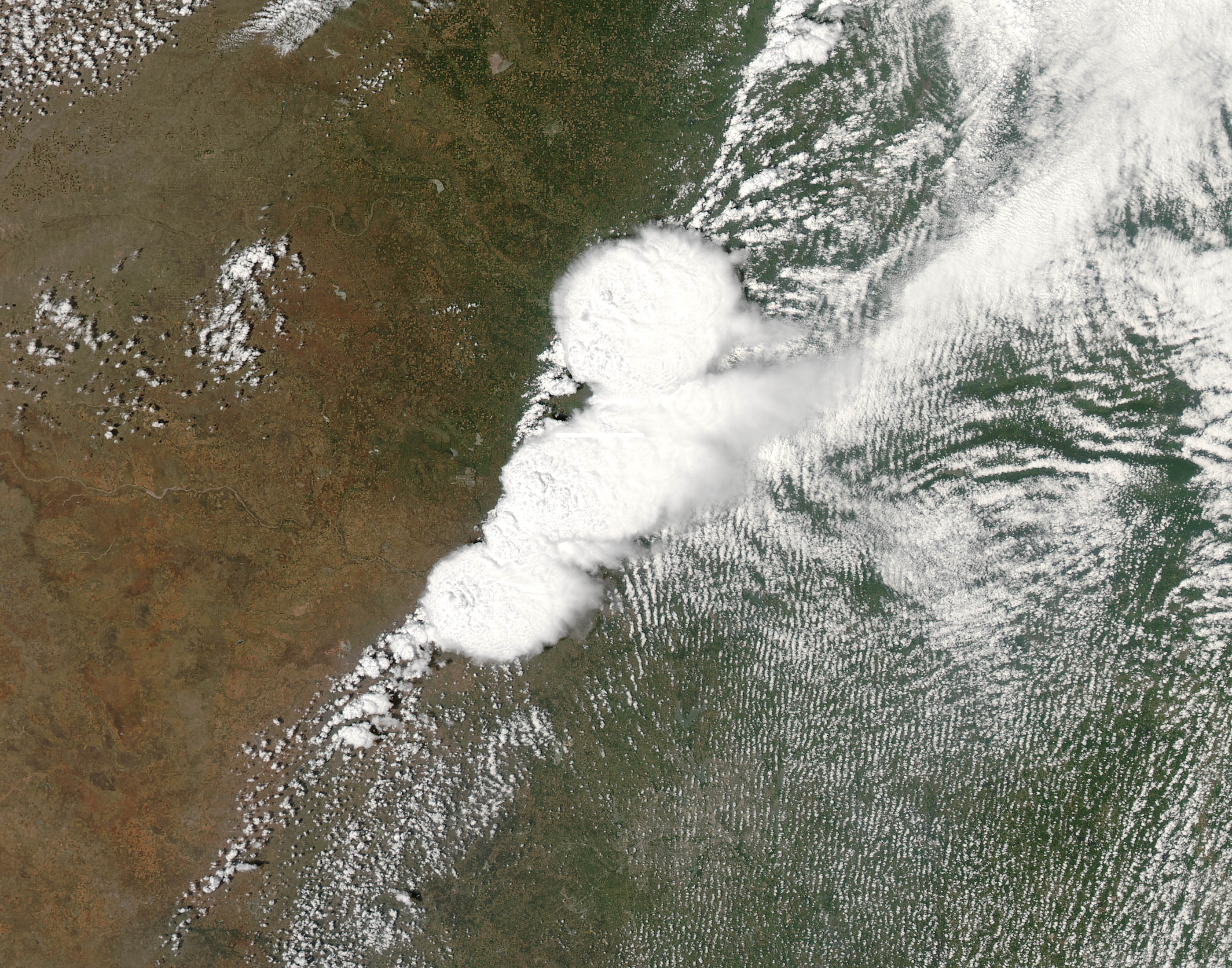
Satellite Image Of Oklahoma Tornado From NASA's MODIS

The Moderate Resolution Imaging Spectroradiometer (MODIS) on NASA’s Aqua satellite acquired this natural-color satellite image of the Oklahoma tornado system at 2:40 p.m. CDT (19:40 Universal Time), just minutes before the devastating twister began.

The red line on the image depicts the tornado’s track.

According to the latest report, 24 have died, including 9 children when the devastating tornado ripped through Moore, Oklahoma Monday afternoon.


Free download large image (1 MB, JPEG, 2800x2200)

Friday, May 17, 2013

Winners: NASA Earth and Space Science Fellowship (NESSF) Program 2013

NASA Earth and Space Science Fellowship (NESSF) Program - 2013 winners announced. Congratulations to the following students and advisors for submitting NASA Earth and Space Sciences Fellowship (NESSF) proposals that were selected for funding.

NASA received a total of 587 applications in 2013 to the NASA Earth and Space Science (NESSF) Fellowship Program announced in November 2012 among Earth Science Research, Heliophysics Research, planetary Science Research, and Astrophysics Research - the four research programs of the Science Mission Directorate (SMD) at NASA Headquarters.

These four SMD science divisions make respective selection of applications for award on a competitive basis. Criteria for evaluation included: (a) the scientific merit of the proposed research; (b) the relevance of the proposed research to NASA's objectives in Earth or space science; and (c) academic excellence based upon an applicant's transcripts, the letter of recommendation by the student's academic advisor, and the degree to which it supported the proposed research. Evaluation was conducted via either mail or panel review, or both, and by the relevant expertise in the science divisions of SMD.

The purpose of the NESSF is to ensure continued training of a highly qualified workforce in disciplines required to achieve NASA's scientific goals. Awards resulting from the competitive selection are made in the form of training grants to the respective universities and educational institutions, with the faculty advisor serving as the principal investigator.

NESSF awards are made initially for one year and may be renewed for no more than two additional years, contingent upon satisfactory progress, as reflected in academic performance, research progress, and recommendation by the faculty advisor, and the availability of funds. An award is $30,000 per annum, including $24,000 student stipend and an allowance of up to $6,000, consisting of $3,000 for student expenses and $3,000 for university expenses.

The student allowance may be used for tuition; fees; travel in support of the research investigation to conferences, symposia, or collaborative meetings; books; expendable laboratory supplies; page charges for journal articles; printing of a thesis; health insurance; and other similar expenses related to the proposed research investigation. The university allowance may be used for tuition or research expenses, if agreed upon by the student and faculty advisor; it may also support research-related travel for the advisor (i.e. to accompany the student to a scientific meeting, oversee the student's research, etc.); or by the student. The budget in these two allowance categories may be exchanged, as long as the total sum for the two combined allowance categories does not exceed $6,000.

An individual accepting this award may not concurrently receive other Federal fellowships or traineeships. However, NASA may allow an applicant to receive supplements from other U.S. Federal agencies to cover expenses not covered by NASA's graduate fellowships; for example, the purchase of equipment, which is not permitted through a NASA fellowship.

The names of the students and their faculty advisors, institutions, and proposal titles of the 2013 NESSF selections are listed below by each of the four SMD science divisions.

The announcement for 2014 NESSF is anticipated in November 2013. The release will be posted at http://nspires.nasaprs.com/external/, and the deadline for submission of new applications to NASA will be February 3, 2014.

Inquiries about the program may be directed to: Program Manager for NESSF Earth Science Research - Dr. Ming-Ying Wei at (202) 358-0771 or by E-mail at mwei@nasa.gov.

Program Manager for NESSF Heliophysics Research, Planetary Science Research, and Astrophysics Research - Dolores Holland at (202) 358-0734 or by E-mail at hq-nessf-Space@nasa.gov.

Earth Science NASA received a total of 330 applications in Earth Science Research and selected 56 for award, pending acceptance by each applicant and their respective institution; they are:

Woubet Alemu (Student); Geoffrey Henebry (Advisor); South Dakota State University
Modeling Land Surface Phenologies and Seasonalities Using Earthlight: A Comparison between Tropical and Temperate Croplands, and Application to Assessment of Agricultural Productivity

Caitlin Andrews (Student); Aaron Weiskittel (Advisor); University of Maine
The Acadian Forest and Climate Change: Analyzing Shifting Species Distributions and Effects to the Carbon Balance

David Austerberry (Student); Chris Ruf (Advisor); University of Michigan
Supporting the Science and Technology Development for the Decadal Survey PATH Mission

Richard Bateman (Student); Weiqing Han (Advisor); University of Colorado
A Study of Climate Change Impacts on Southwest United States Water Resource and Policy Implication: Analyses of Satellite Data in Conjunction with Surface-Based Observations and Climate Model Simulations

Alexandra Bausch (Student); Joaquim Goes (Advisor); Lamont Doherty Earth Observatory
Assessing the Causes for the Rise in Abundance and Seasonal Productivity of the Green Mixotrophic Dinoflagellate Noctiluca in the Arabian Sea Ecosystem

Michael Beland (Student); Trent Biggs (Advisor); San Diego State University
Mapping Oil-Impacted Vegetation in Louisiana Salt Marshes: Investigating the Effects of Endmember Spatial, Temporal and Inter-Specific Variability on Vegetation Cover Estimates

Erin Black (Student); Ken Buesseler (Advisor); Woods Hole Oceanographic Institution
Integrating Remote Sensing and Field Observations of Controls on the Ocean Carbon Cycle by the Biological Pump

Forest Cannon (Student); Leila Carvalho (Advisor); University of California
Western Himalaya Climate Variability: The Recent Trends In Large-Scale Circulation and Local Precipitation Impacts

David Chen (Student); Chris Ruf (Advisor); University of Michigan
Characterization of the Delay and Decorrelation of Sea State to Local Wind Forcing for L-Band Remote Sensing of Ocean Surface Windspeed

Sungho Choi (Student); Ranga Myneni (Advisor); Boston University
Refinement, Evaluation and Application of Allometric Scaling and Resource Limitations Model of Forest Canopy Height and Biomass Through Synergistic Optimization With Spaceborne and Airborne Lidar Waveform Data

Ryan Davis (Student); Margaret Tolbert (Advisor); University of Colorado
Amorphous Phase States of Atmospheric Particles Studied in an Optical Trap: Implications for Global Climate and Air Quality

Andrew Delman (Student); Janet Sprintall (Advisor); Scripps Institution of Ocenaography
Influence of Kelvin Waves and Salinity on Developing Positive Indian Ocean Dipole Events

Ksenia Dmitrieva (Student); Paul Segall (Advisor); Stanford University
Improved GPS Velocity Uncertainties

Debsunder Dutta (Student); Praveen Kumar (Advisor); University of Illinois
Assessing Disaster Impact From Large Scale Floods Using Hyperspectral Remote Sensing

Nan Feng (Student); Sundar Christopher (Advisor); University of Alabama in Huntsville
Understanding the Climatic Impacts of Land Use Change and Biomass Burning Aerosols over Southeast Asia Using Numerical Models and Satellite Observations

Nandita Gaur (Student); Binayak Mohanty (Advisor); Texas A&M University
A New Heterogeneity Triangle to Characterize Land-urface Heterogeneity for Estimating Near-Surface Soil Moisture Beyond Darcy Scale

Aimee Gibbons (Student); James Famiglietti (Advisor); University of California, Irvine
Estimating Groundwater Quality Variations Using GRACE

Nick Heath (Student); Henry Fuelberg (Advisor); Florida State University
Impacts of Asian Summer Monsoon Convection on the Chemical Composition of the Upper Troposphere and Lower Stratosphere

Kimberly Huppert (Student); Taylor Perron (Advisor); Massachusetts Institute of Technology
Climatic and Geodynamic Influences on Ocean Island Landscape Evolution

Matthew Igel (Student); Susan van den Heever (Advisor); Colorado State University
Observed Environmental Influences on Convective Morphology

Stephen Klosterman (Student); Andrew Richardson (Advisor); Harvard University
Improving Predictions of Terrestrial Carbon, Water, and Energy Cycling Using Novel Plant Phenology Observation and Modeling

Caitlin Kontgis (Student); Annemarie Schneider (Advisor); University of Wisconsin Nelson Institute
Urbanization, Climate Change, and Rice Crop Sustainability

Karl Lapo (Student); Jessica Lundquist (Advisor); University of Washington
Improving Estimates of the Radiation Balance of Snow Covered Complex Terrain Using MODIS and CERES Data

Zuchuan Li (Student); Nicolas Cassar (Advisor); Duke University
Derivation of Global Net Community Production and Assessment of Regulating Factors Using In-Situ Measurements and Remotely Sensed Properties

Dongyue Li (Student); Michael Durand (Advisor); Ohio State University
Improving the Understanding of Snow Water Equivalent and Melt Timing in the Sierra Nevada by Assimilating AMSR-E L2A Brightness Temperature Into a Land Surface Model

Yang Li (Student); Allison Steiner (Advisor); University of Michigan
VOC Oxidation in the Atmospheric Boundary Layer

Pengfei Liu (Student); Scot Martin (Advisor); Harvard University
Wavelength-Dependent Complex Refractive Indices of Light-Absorbing Secondary Organic Material: Updating the Aerosol Optical Database to Improve the Accuracy and Scope of Satellite-Retrieved Information

Xiaojian Liu (Student); Jeremy Bassis (Advisor); University of Michigan
A Numerical Investigation Into the Supra-Glacial Hydrology of the Greenland Ice Sheet

Dylan Lusk (Student); Steven Cavallo (Advisor); University of Oklahoma
Predictability of Midlatitude Cyclones in Relation to Tropopause-Based vortices over the Arctic, and Sensitivity to Reductions in Sea Ice

Selena McKibben (Student); Angelicque White (Advisor); Oregon State University
Merging Satellite and Slocum Glider Data to Optimize chl-a Quantification in Oregon's Coastal Waters

Kevin McLean (Student); Oswald Schmitz (Advisor); Yale University
Use of Airborne LiDAR to Model Three-Dimensional Habitat Use by Neotropical Primates

Katherine Mertes (Student); Walter Jetz (Advisor); Yale University
Using Multi-Platform Remote Sensing Data to Predict Vertebrate Species Distributions Across Spatial Scales

John Mioduszewski (Student); David Robinson (Advisor); Rutgers University
A Multi-Method Approach to Improved Understanding of Terrestrial Snowmelt in a Warming World

Jerome Mitchell (Student); Geoffrey Fox (Advisor); Indiana University
Developing Machine Learning Algorithms to Access Bedrock and Internal Layers in Polar Radar Imagery

Christopher Moran (Student); Mark Cochrane (Advisor); South Dakota State University
Quantifying Fuel Treatment Effectiveness Over Time and in Extreme Weather Conditions

Jamiat Nanteza (Student); James Famiglietti (Advisor); University of California, Irvine
The Changing Water Resources of East Africa: Understanding the Causal Linkage Between Surface Water and Groundwater Variations Over East Africa Using GRACE, Altimetry and LSMs

Adriana Raudzens Bailey (Student); David Noone (Advisor); University of Colorado at Boulder
Constraining Vertical Exchange of Moisture Between the Boundary Layer and Free Troposphere Using Stable Isotopes in Water

Sami Rifai (Student); Stephanie Bohlman (Advisor); University of Florida
Determination of Tropical Forest Blowdown Frequency is Necessary to Understand the Regional Carbon Balance of the Northwestern Amazon

Sarah Ringerud (Student); Christian Kummerow (Advisor); Colorado State University
Building the Foundations for a Physically Based Passive Microwave Precipitation Retrieval Over the Southern Great Plains

Lauren Schaefer (Student); Thomas Oommen (Advisor); Michigan Technological University
Application of Remote Sensing and Numerical Modeling to Volcanic Hazard Monitoring

Danica Schaffer-Smith (Student); Jennifer Swenson (Advisor); Duke University
Spatiotemporal Variability of Inland Waterbodies Along the Pacific Flyway Using 30+ Years of Landsat

Amanda Schwantes (Student); Robert Jackson (Advisor); Duke University
Quantifying Drought-Induced Tree Mortality at Multiple Scales Across Texas: Regional Carbon Cycling, Biophysics, and Regime Shifts

Scott Sellars (Student); Soroosh Sorooshian (Advisor); University of California, Irvine
An Application of Object Based Methods and Machine Learning to NASA's Satellite Precipitation Data for Pattern Detection and Prediction of Regional Climate

Nicholas Smith (Student); Jeffrey Dukes (Advisor); Purdue University
Improving Earth System Models Via Incorporation of Temperature Acclimation of Plant Carbon Exchange

Theresa Stumpf (Student); Sivaprasad Gogineni (Advisor); University of Kansas
Ultra-Wideband, Wide-Swath Radar Imaging of the Ice-Bed Interface for Generating Fine Resolution Bed Topography and Quantifying Basal Conditions

Sylvia Sullivan (Student); Athanasios Nenes (Advisor); Georgia Institute of Technology
Mixed-Phase Cloud Parameterizations Within Global Climate Models

Joseph Tamborski (Student); Deanne Rogers (Advisor); Stony Brook University
Regional Characterization of Spatial Variability in Submarine Groundwater Discharge: Understanding Flux Signatures in Thermal Infrared Data and Geologic Controls

Andrew Thorpe (Student); Dar Roberts (Advisor); University of California, Santa Barbara
Mapping Local Greenhouse Gas Emissions Using Airborne Imaging Spectrometry

Mary Upshur (Student); Franz Geiger (Advisor); Northwestern University
Synthesis and Analysis of Putative Secondary Organic Aerosol Particle Constituents

Chris Waigl (Student); Martin Stuefer (Advisor); University of Alaska, Fairbanks
A Validated Remote Sensing Approach to Support Emissions Forecasting and Management of Alaskan Wildfires

Jennifer Watts (Student); John Kimball (Advisor); University of Montana
Potential Contrasts in CO2 and CH4 Flux Response Under Changing Climate Conditions: Satellite Driven Analysis of the Net Ecosystem Carbon Budget for Arctic and Boreal Regions

Michael Wolovick (Student); Robin Bell (Advisor); Lamont-Doherty Earth Observatory of Columbia University
Ice Sheet Sliding Constrained by Assimilation of Stratigraphic Data

Kendra Wright (Student); Claudio Mazzoleni (Advisor); Michigan Technological University
Radiative Properties of Free Tropospheric Aerosols in the North Atlantic at the Pico Mountain Observatory

Wondmagegn Yigzaw (Student); Faisal Hossain (Advisor); Tennessee Technological University
The Future of Our Cities and Ageing Dams: Using NASA Satellites to Understand Changing Patterns of Infrastructure Safety for Resource-Hungry US Cities

Lei Yin (Student); Rong Fu (Advisor); University of Texas at Austin
Rainfall Extremes and Variability Over Amazonia: Understanding the Mechanisms and Consequences Using Satellite Observations and CMIP5 Models

Jie Zhang (Student); Chris Justice (Advisor); University of Maryland
Global Agricultural Drought Monitoring From Satellite Observation

Thursday, May 16, 2013

NASA Accepting Proposals for Tribal College and University

The National Aeronautics and Space Administration Office of Education is accepting proposals in response to the Education Opportunities in NASA STEM (EONS) 2013-14 NASA Research Announcement.  This new announcement is an umbrella announcement for opportunities under the Minority University Research and Education Program (MUREP), and includes calls for proposals in the following program elements for Fiscal Year 2013:

•    NASA Innovations in Climate Education - Tribal (NICE-T)
•    Tribal College and University Experiential Learning Opportunities – (TCU ELO)

Eligibility Information: Proposals will be accepted from Tribal Colleges and Universities. NASA centers and other organizations may apply through partnership with the lead organization in some cases.

Notice of Intent due date: May 22, 2013.

Full proposals due: July 24, 2013.

Interested parties may also attend or connect to a pre-proposal workshop on the TCU-ELO program element on May 21, 2013, at 1:30pm EDT for further information on that program element.  Call-in information: 1- 888-790-2014.  Pass Code: TCU-ELO 2013. 

For more information regarding this opportunity, please visit the EONS page on the NSPIRES website at http://go.nasa.gov/14So8d6.

If you have difficulty accessing the full announcement electronically, please contact the NSPIRES Help Desk at nspires-help@nasaprs.com or call 202-479-9376 between 8:00 a.m. and 6:00 p.m. Eastern Time.

Tuesday, April 30, 2013

2013 NASA EONS Solicitation: New Proposals Now Accepted

NASA's Office of Education is accepting new proposals under the Education Opportunities in NASA STEM (EONS) 2013 NASA Research Announcement.

This is an umbrella announcement for opportunities under the Minority University Research and Education Program, or MUREP, and includes calls for proposals in the following program elements for FY 2013-2014: Tribal Colleges and Universities Experiential Learning Opportunities (TCU ELO) and NASA Innovations in Climate Education – Tribal (NICE-T).

Proposals for both opportunities are due July 24, 2013.

For more information regarding these opportunities, please visit the NASA EONS page on the NSPIRES website at http://go.nasa.gov/14So8d6.